By NAVEED GILANI
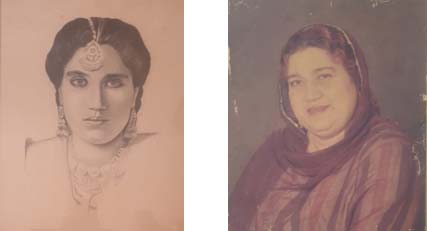 Minoree was a no-nonsense lady. The only word in colloquial Urdu that describes her well is dabung – with all its nuances and implications. For non-Urdu speakers, the word refers to someone who is boldly self-assured, fearless, and authoritative. Though, just below her stern exterior she was also love and affection. With no pretense, she embodied an earthy sincerity, an earnest spirit, and a forthright strength that made her both pragmatic and formidable.
Her formal name was Munawar Sultana and she was my beloved Ammi (mother), delicately pretty as a child, handsome and charming as a young woman, and elegantly graceful as an older woman. Our Abbu (dad) called her Minow.
The eldest daughter in the family; she was bajigul to her 8 siblings. To the younger siblings, she was a second mother who, as a young girl, often sacrificed her youthful mischief to serve as a surrogate for her mother. This early touch of motherhood forged remarkable personal qualities of caregiving and emotional support that became her hallmark.
Her dad worked for the much-desired employer of the time, the Indian Railways. She moved with the family to wherever her dad was posted, spending her formative years in various towns and cities across undivided India. Absorbing the cultural and ethnic hues of children of all ilks she blossomed with a fascinating blend of progressive and liberal views sitting comfortably on a conservative foundation grounded in tradition.
Being the firstborn, she was her father’s darling. When she was a child, he would love to see her dressed beautifully – puffed sleeved taffeta frock paired with ribboned hair and a hat, complete with ankle socks and delicate shoes. She was his little memsahib. Much later Minoree would fondly recollect her father taking his little memsahib to Delhi’s historic heart – red fort, humayun’s tomb, chandni chowk, Jamia masjid, and all in the stately comfort of a horse carriage. How she delighted in the memory of the loving attention she had received.
In days of yore, conservative families typically educated girls with skills to manage their household – rearing children, managing domestic duties, and practicing the crafts of knitting and sewing. Hers was gilded with modest academic education, enough to nurture her literary spirit alongside her traditional role of the time. She was a keen reader of contemporary literature and expressed her voice in short stories that were published in popular women’s magazines of her time.
Ammi’s paternal home ground was the tribal valley of Kohat – rustic and simple with traditional values and conservative beliefs. Her summer holidays were spent there. The childhood spent in her beloved Kohat left an everlasting lure and affection for its people, its sights, and its sounds. The strings that tied her to Kohat stayed strong even when she moved far away and had lost the strength to pull on them.
Providence bestowed her a heart as vast as the Grand Canyon, cradling love as boundless as the Colorado River. One of her worldly-wise lore was: love is like water, it flows downstream. And so did her love; not just downstream but sometimes breaching its boundaries too. In youth, it nourished her maiden family, then widened to embrace and nourish both them and the family she nurtured in marriage. From the simple joy of hand-knitting a bright red wool sweater for her well-loved brother who longed for it dearly; to leaving her married home to nurse her mother through weary months; to arranging a residence for siblings when their families were most unsettled; to the profound gift of adopting a beautiful little baby girl for the eldest of her brothers – she was always there for them.
She married a man she had never met before her wedding, but their love grew silently, forever blooming. The home that they built together was a place of comfort and belonging, where family ties were strengthened and traditions of warmth and care were upheld. Her home embodied the essence of Eastern hospitality. She had entered her husband’s family as a young bride, embracing them with her enduring love and devotion as if they were her own. The new family felt, too, that she always belonged among them. Her doors were always open to relatives and friends. They felt free to come and stay for extended periods, sometimes spanning weeks and at times even months. Each guest was welcomed with grace and generosity, ensuring that no one ever felt like a burden.
In that haven of love and warmth, I spent my childhood and teenage years. It was the best of times; all my desires, innocent cravings to heady impulses, were gladly fulfilled. I had learnt to exploit my oldest boy’s status, but her motherly generosity was carefully balanced with the quiet gaze of a hawk. Early discipline had taught me to know where the red lines were. As a boy, leaving the house required permission, which was not always granted. As a teenager, out-of-home time ended at sunset. Pouting was strictly prohibited after a good scold that was sure to come swiftly after any infraction. I resented her strict regimen, especially when I saw how freely my friends were treated by their moms. On my complaining, she would even chide those mothers on how they ought to be stricter—and later laugh about it. Her strictures also drifted toward my friends, who scurried to escape her gaze—much to her amusement. Amid all this sternness toward me, I felt my younger brothers’ boundaries were drawn in sand; I felt less loved.
I left home when I was 20 to make my own story, always reaching back for her wisdom and support in the matters of the heart and soul. At one major fork I set my steps upon a path her wisdom would not have chosen. At first there was active persuasion, dissuasion, and maternal efforts to turn me back, yet in time understanding grew, and her love walked beside me still. My toil years took me to distant horizons. My brothers and sisters treaded away on their own journeys. She remained the keeper of the hearth for all our kin, near and far, young and old. It is now that I hear stories of her sagacity, her love, her empathy, and her quiet beneficence from those kin. At 64, after a life of striving and fulfillment I docked back at my mother ship. It was indeed great to be back and have an encore of the earlier blissful years. This time she wasn’t as dabung as she had been, but active enough, when needed, to spring back to her younger self in full colour.
In time, she lost her life partner, my Abbu. It wasn’t the same afterwards. Life resumed its course, steady but subdued, with less urgency, yet embraced without grievance. Her rhythm had surely changed. Soon after, she lost one of her limbs to diabetes. Now fully dependent on caregiving, she remained tough. We stayed close to embrace the fullness of her. Even in our own autumn years, she was still the glue that bound us siblings together. Whenever any one of us were away we would connect on a video call, but there came a time when she would not feel up to a call. A few months ago, when I was away and she couldn’t manage it, my brother shared a video of her; she looked very frail. It pained me to see her wide eyed and vacant. She seemed to have arrived at the natural completion of her course.
When I was six, Ammi had to go away to her parents leaving me and my elder sister behind with Abbu. That is the memory of my first separation from her. In those puppy years, my small world suddenly turned gloomy; that parting caused me to look at everything with sad eyes. I thought, surely nobody could understand my pain. Not long after I’d grin remembering those innocent feelings.
My final separation from Ammi came two months ago. I crossed oceans to be there to see her off. She had been readied for her final journey. Her dad’s little memsahib still looked delicately pretty but this time she was in a shroud, lifeless and helpless. I again thought, surely nobody could understand my pain. Then I remembered, ‘say not in grief that she is no more but say in thankfulness that she was’. Her room was empty the next morning; her bed had not been slept in. My eyes welled as I looked in. I didn’t wait for her for breakfast. I went to visit her on the memory lane; she would always be there for me.
She left behind her legacy – love that warmed, comfort that endured.
Her epitaph reads “she lived with love and served with strength; her grace endured, and her kindness lives on in all she touched”.
I vow to carry her love forward and to remember that unity of family is her greatest gift. I vow to turn the grief of her final separation into a celebration of the 95 years that she spent in this world, of which 70 are for me to cherish and treasure.
January 2026